His Intentional, Purpose-full Life

Never was a life so driven, not by self but by His God, to be full of purpose, moment by moment.

There were brief moments of ‘rest’ and those may have been more for the benefit of His flagging disciples than for Himself. But do we ever see Him folding his hands (Proverbs 6:10), slumbering through boredom (vs. exhaustion), wasting the day away?

Gathering

It seems it has always been God’s desire to invoke a gathering.

Not simply a meeting. There is a more amiable, genial sense to it, that believing ones should come together with purpose, partly for warm fellowship with themselves but mainly to gather round Him. Actually, it is He that gathers us, like a mother seeking out her children and bringing them to one place of refuge, hospitality and abudant life.

You can think of the simple fellowship of God walking with Adam in the cool of the day, or the bedouin warmth shared by God with Abraham as he reclined over a meal, or the bread and wine enjoyed amongst the terror of Sinai between the elders of Israel. All are evocative pictures of the intimate fellowship God chooses to have with us.

And so it will always be. Whether in Solomons great temple or the fleshy tables of our heart, he desires to dwell and gather us to Him. It is strange to think of this since we are naturally at emnity with Him and whilst His hand is not shortened, our sins have brought separation between us.

But it is stranger still that in order to create a gathering of the kind we enjoy today, He would ultimately forsake His Son. How incongruos and incredible. Forsaken that we might have fellowship. Wounded that we might know warmth. Made guilty that we might be gathered.

Casting pearls before swine

The Lord cautioned the disciples to use discretion when sharing the truth of the kingdom. Yet no such discretion seems to have been at work when God sent His Son.

They would behave as dogs towards This Holy One and as swine before The Pearl. Ultimately they would trample Him under foot and all but rend Him.

How gracious of our God to use no discretion but to fully give to our depraved world His only Son, fully exposing Him to the animal behaviours of his creature in order that those same dogs and swine would become kings and priests towards God!
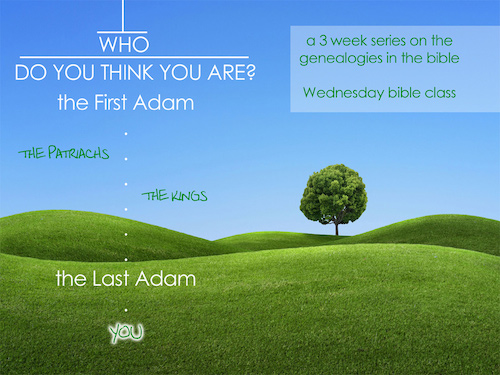
Who Do You Think You Are: The Lord Jesus

flyerWeb

Infographic here.

What we learnt, God is a God of

  • Grace – again we see God’s grace with so many of the forefathers of the Promised One been characterised by failure, yet because of a measure of faith God imparts His Righteousness to them
  • Beautiful revelation – the way God inspired the writing of these genealogies is just that, inspired, a real cause for worship
  • Love – that God would Himself would enter in to history, become part of the story of these genealogies, part of the family, blows our minds

The Four Gospels

  • John traces the Lord Jesus’ genealogy back into Eternity, as the one who is God and then came to dwell amongst us (John 1:14)
  • Mark makes no record of the Lord Jesus’ genealogy for as a servant, he had no rights, he had no records associated with his history. And indeed, the Lord Jesus never claimed anything though He owned the cattle on a thousand hills, the wealth of every mine – He came not to be served but to serve and give his life a ransom for many (Mark ?:?);
  • Luke traces the Lord Jesus’ genealogy back to Adam (end of ch3) showing the Lord Jesus to be truly man but then follows it abruptly with a record of the Lord Jesus’ perfection in ch4; now ascended in heaven the Lord Jesus is that perfect man who fully understand what it means to be human with all its confines and troubles
  • Matthew traces the Lord Jesus’ genealogy back to David to prove His rights to the throne of Israel; in a coming day He will rule for 1000 years, physically, literally in Jerusalem
    * This is the family of Joseph, the husband of Mary
    * The missing names of evil kings remind us of Ex 32:33 where God says “”
    * The uncharacteristic mentioning of womens names, especially Tamar, Rahab, Ruth and Bathsheba remind us that God is gracious where we show faith, despite failure

1. Roboam begat Abia;
that is, a bad father begat a bad son.
2. Abia begat Asa;
that is, a bad father, a good son.
3. Asa begat Josaphat;
that is, a good father, a good son.
4. Josaphat begat Joram;
that is, a good father, a bad son.
I see, Lord, from hence, that my father’s piety cannot be entailed; that is bad news for me.
But I see also that actual impiety is not always hereditary; that is good news for my son.

(Thomas Fuller,
quaintest of English divines,
in his Scripture Observations)

Practical Lessons

  • The genealogies as far as Japheth are our story and from there came the european populations down the ages to what today is Great Britain; we are British people (the word ‘ish’ being like the Hebrew word for ‘man’); to that extent we have rights that can
  • Every one that is born belongs to the natural family of Adam
  • Every one that is born again through faith in the Lord Jesus belongs the the spiritual family of Christ
  • Because of Adams sin (Rom 5), everyone in the family is dead in trespasses and sins (Eph 2); since Christ came in and began a new family God is finished with the natural family apart from His purposes for Israel
  • Because of Christs’ death, those in the family of God know sins forgiven; because of His resurrection, we know life
  • This shows that the promise of the womans seed in bruising the serpents head was fully kept by God
  • In a coming day, God will create a new heaven and earth and this new family, under Christ will dwell there for evermore
  • For today, as Christians, we should live as citizens of heaven, reckoning our old ties to Adam as being over and live in newness of life

Who do we think we are
We are children of God and that has certain privileges

  • Part of the family of God – we can go anywhere in the world and find ‘family’
  • Spiritual blessings: forgiveness; indwelling of the Holy Spirit; set apart for God;

What a heritage we have and how our walk should thus be affected.

Who Do You Think You Are: The Kings

What we learnt, God is a God of

  • Grace – through the tragic beginnings of the family of Judah comes a line of men and women who prevail against the odds and whom God is happy to use for His purposes despite their failure
  • Sovereignty – He was, is and will always be the ultimate sovereign, ruler

1 Chronicles 1
First and Second Chronicles were likely written after the return from Babylon. Thus whilst there are similarities with the First and Second book of Kings, both offering a history of the the Jewish monarchy, the perspective in Chronicles is more one of reflection and only the details of the Southern Kingdom are recorded. Perhaps there was even a wished for notion in his mind of the writer that there should only have ever been one kingdom and to the extent that the whereabouts of the Northern Kingdom and its peoples were largely unknown, he reflects on and record only what he deems are the note-worthy details of the nation that remains.

Having established the particular character of this record we should note:

  • chapter 1 is a genealogy which will clearly embed Jewish history in the context of world history as a whole.
  • As he moves toward documenting the history of the monarchy he includes reference to other power influences in the region – hence the mention of the Dukes of Edom.
  • As the genealogy develops we can see that he is really only interested in the Kingly line and chapter 4 begins with Judah, overturning the order of birthright which would place Reuben first.
  • The question arises at this point as to why the Kingly line comes from Judah. And the kingly line ultimately will be the Messianic line. Why wasn’t it from Joseph? It’s an interesting point because some of the later writers will refer to the Southern Kingdom as Ephraim – one of Josephs Son’s – but the Kings that reigned there came from Judah’s line. There were many things which made Judah an unlikely candidate:
    • he wasn’t the first-born
    • his mother was  Leah – not Jacobs favourite
    • he consents to Josephs death along with the other brothers
    • he engineers the sale of Joseph and the other brothers follow his lead
    • he mercilessly deceives his father with the rest of them
    • in Gen 38 a whole chapter is given over to Judah which makes for very unpleasant reading including his ungodly friendships and his lurid relations with his own daughter-in-law – it might be asked – ‘why would a whole chapter be given over in this way’
    • the answer of course is because the events therein are absolutely pivotal in setting the scene for Judah’s ascendancy. What emerges from this is fascinating:
      • Judah is deprived by God of two of his sons reducing his chances at posterity (a poignant situation given he had deprived Jacob of one of his)
      • the two sons that come from Judah’s relations with Tamar – the birth event is recorded in particular detail owing to the unusual circumstances – the firstborn is named Pharez (Perez) because he evidences the characteristic that he overcame the odds. Against all expectations he overcame. This of course is the very characteristic of the Messianic line but it also signals a change in the life of Judah himself
      • and so when we come to chapter 42-43, the focus on Judah narrows. Initially, all the brothers are in view. Reuben underlines his unsuitability as the leader with his rash comment to his father, ‘“Kill my two sons if I do not bring him back to you”. By contrast Judah takes proper charge and is recorded as having said “I will be a pledge of his safety” – he makes a composed and mature pledge that convinces his Father to allow Benjamin to head to Egypt.
      • and then finally, it is Judah, when Benjamin’s life is in the balance (no doubt reflecting on the pain himself, of have being deprived of two sons and contemplating the bitter anguish it would bring to Jacob), he steps up to Joseph (Gen 44:18) and pleads with genuine, deep-felt, desperate emotion, Joseph’s mercy. It is these words from Judah which break Joseph down and reconciliation ensues. Judah breaks forth against the odds and overcomes. And with that crescendo, we are not surprised to hear Jacob’s blessing, ‘Judah, your brothers shall praise you…the scepter shall not depart from Judah’
    • this meta-narrative is patently obvious when you realise how significant Judah is to the end of the book of Genesis. Genesis being the book of beginnings of course, the seed-plot for the bible
    • and so we answer the question as to why it is that Judah, despite his pitiful beginnings, became the tribe from which the Messiah would come. It is a story of one thing – God’s abounding grace.

What’s not there

  • no mention of Dan (cf. Judges 18)


Who Do You Think You Are: The Patriarchs

Intro

a study on the Genealogies of the Bible – we are the people our History has made us. That is somewhat to state the obvious but when we speak of History we are ultimately referring to God’s unfolding revelation and not a story of our own making.

What we learnt, God is a God of

  • History – our faith is not based on legend and myth, we saw from Genesis that the events of Eden, the Flood and Babel shaped our world as it appears today
  • Purpose – God has a plan, a big big plan and He will work it out – nothing can get in its way
  • Promise – God reveals His purpose to us in promises, binding Himself to do what He says He will
  • Family – this is the ultimate vehicle through which He will bring into the world The ‘seed’ and reminds us of the common brotherhood we all have (Acts 17.?)

Gen 4 & 5
Cains family is detailed in Gen 4.17-22. Note:

  • the lack of age related information – age data is a distinctive feature of those genealogies from which the ‘seed’ would come (cf Gen 10,11 & 36,37); God is careful to establish accurate genealogical data to establish the families of the promised One
  • the record of natural gifts (famers, shepherds, musicians, metallurgist)

Seth’s family is detailed in Gen 5. Note:

  • the record of spiritual men characterised by ‘Calling upon God’ (Gen 4.26), ‘Walking with God’ (Gen 5.22) & ‘Believing in God’ (Gen 5.29)
  • the refrain ‘and he died’, reminding us that though this family were waiting for promised ‘seed’, being from Adam they inherited Adams sin and death

Visual Aids
Chart showing overlap in generations of Seth
Longevity: Compare Adam to Noah with Shem to Abraham

Gen 10 & 11
Between these genealogies and those of cha 4 & 5 the following events occur

  • the flood takes place
  • it is possible that the cataclysmic conditions of the flood would cause spread in land mass or that this occurred in the days of Peleg during which according to Gen 10.25, the earth was divided (continental drift)
  • God mandates Noahs family to replenish the earth 9.1 & 9.7
  • God establishes three families on the basis of Noah’s three sons – Shem, Ham & Japheth
  • because of Hams sin in dishonouring His father, Ham’s family would serve Shem & Japheth whilst Japheth would dwell together with Shem – this prophecy which was evidently imparted through Noah by God, is startlingly evident from history; Ham has both served in a technological sense (the Hamitic nations were the first to advance technology) and in a political sense (though Ham’s slavery is not in view, God does not condone slavery)

The genealogies of Noah’s sons are detailed in Gen 10. Note:

  • the families of Japheth: we only recognise Tarshish (from the story of Jonah), being located in Spain; historians understand the other locations to be simarlarly located in Europe
  • the families of Ham: Ham = hot; Cush = Black and ono ancient maps occupied the are of Ethiopia; and so it is understood that the families of Ham settled in modern day Africa; Nimrod was a mighty warrior against God, his name means rebel
  • the families of Shem: from which came Eber, the father of the Hebrews; it is possible that the families of Shem spread out Eastwards to occupy the land occupied today by Asia (the family of Joktan for instance).

Visual Aids
Map showing territories occupied by Noahs sons (bear in mind that exact territories are debatable)
Graphics used to illustrate continental drift discussion
Map used to illustrate how families would have spread after flood using land bridges

Other notes:

  • it is obvious that Adam and Eve’s children included women and that God permitted Cain & Seth to take their sisters to wife; this was only outlawed under the Mosaic law and was as much to avoid children being born with deformities (see next point)
  • Adam and Eve’s genetic makeup would have been highly stable and only with the entrance of sin did the potential for bad genetic mutations begin; this would have been exacerbated after the flood since the eight that came out of the ark had far less stable genetic makeup (relatively limited gene pool – this would also go some way to explain why longevity free-fell after the flood)
  • If Eden was located in the middle east, it is probable that Adam and Eve were Arab looking in appearance with a balanced amount of melanin (defines skin colour) in their skin; this would have ensured that even whilst fully naked their skin would be protected from harmful radiation (though the effects of such would not really have been a problem anyway before the fall) whilst at the same time receiving enough sunlight to produce sufficient vitamin D to support a healthy body. The absence of the canopy which was released during the flood would also have increased harmful radiation further accelerating the level of bad genetic mutations and ultimate disease, especially by those families that settled in any climates where they had not adapted to the different levels of sunlight
  • Even modern secular history traces us all back to one mother, apparently in Africa but at least, to a common ancestor; this mother is known as Eve

Comedic news article about the confusion at Babel:

Babel Humour